
How to choose the right enclosure cooling fans for your equipment
Choosing a matching enclosure cooling fans for your equipment is a highly precise technical decision. The core lies in achieving a balance between thermal load and heat dissipation capacity. An error of more than 10% May lead to a 30% reduction in equipment lifespan. First of all, the total heat load inside the cabinet must be precisely calculated, with the unit being watts (W). For instance, a control cabinet equipped with five servo drives may generate a total heat of up to 850W. According to the industry standard IEC 61439, the minimum air volume (CFM) required by the cooling fan can be estimated by the formula [CFM = (thermal load Wattwatts × 3.16)/allowable temperature rise °F]. If the internal temperature is to be controlled within 10°C higher than the ambient temperature, approximately 269 CFM of air volume is needed. In 2024, during the construction of its new factory, TSMC underestimated the heat load by 20%, resulting in insufficient cooling efficiency of the first batch of fans. It had to urgently replace the models, causing the project to be delayed by two weeks and resulting in losses exceeding 1 million yuan. This case highlights the importance of precise thermal calculation.
The second step is to assess the environmental conditions and protection level, which directly affects the lifespan and reliability of the fan. If the equipment is located in a dusty workshop with a dust concentration exceeding 5mg/m³, it is crucial to choose a filter fan with a protection level of IP55 or above. This fan can effectively block particles larger than 1 micron in diameter, increasing the mean time between failures (MTBF) from 25,000 hours to 40,000 hours. On the contrary, in high-temperature and high-humidity environments, such as in the southern coastal areas, where the ambient temperature remains above 35°C throughout the year and the relative humidity exceeds 80%, it is necessary to select models with a working temperature range of -20°C to 70°C and a shell anti-corrosion grade reaching NEMA 4X. For instance, when the automated terminal of Qingdao Port upgraded its cooling system in 2023, it selected smart fans equipped with humidity sensors to stably control the internal humidity of the cabinets between 40% and 60% RH, reducing the corrosion rate of electronic components by 15%.
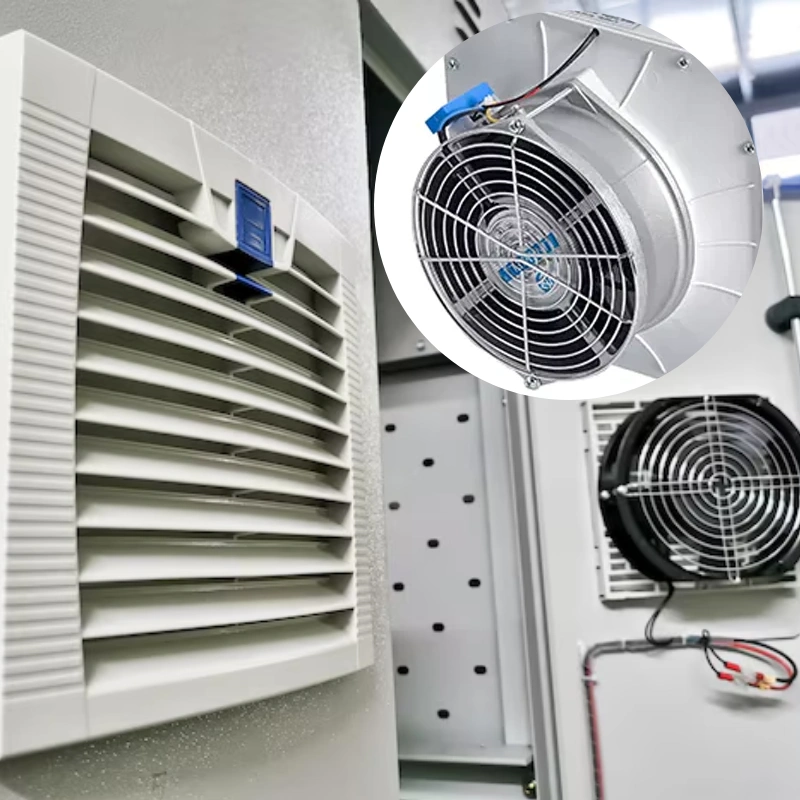 The energy efficiency and total cost of ownership (TCO) of fans are another key dimension. A DC inverter fan with a rated power of 80W, compared with a traditional 120W AC fan, can save up to 350 kilowatt-hours of electricity annually and nearly 300 yuan in electricity costs when operating 24 hours a day throughout the year without a break. Usually, the initial investment cost can be recovered within 18 months through the energy consumption difference. According to a research report by the US Department of Energy, increasing the efficiency of fans by 10% can reduce maintenance costs by 25% throughout their entire life cycle. Take Schneider Electric's EcoStruxure platform as an example. Its smart fans can dynamically adjust their rotational speed based on real-time temperature, with a fluctuation range controlled within ±5%. This not only reduces noise from 65 decibels to 50 decibels but also extends the expected service life from 5 years to over 8 years.
The final decision should take into account both supply chain stability and compliance certification. Ensuring that the selected fan complies with international standards such as UL 507 or CE can reduce the probability of safety risks to less than 0.1%. During the global chip shortage crisis in 2022, some manufacturers' lead times were extended from 4 weeks to 20 weeks due to reliance on a single supplier, while enterprises with diversified procurement strategies managed to keep the impact within 2 weeks. It is recommended to conduct a small-scale trial run, collecting at least three months 'worth of temperature, vibration and power consumption data, with a sample size of no less than 1,000 groups. Through regression analysis, verify whether the deviation of fan performance from the nominal parameters is within the allowable ±5% error range. The right choice is like installing an efficient pacemaker for the equipment, ensuring that the production pulse is stable at a rhythm of 99.9%.
The energy efficiency and total cost of ownership (TCO) of fans are another key dimension. A DC inverter fan with a rated power of 80W, compared with a traditional 120W AC fan, can save up to 350 kilowatt-hours of electricity annually and nearly 300 yuan in electricity costs when operating 24 hours a day throughout the year without a break. Usually, the initial investment cost can be recovered within 18 months through the energy consumption difference. According to a research report by the US Department of Energy, increasing the efficiency of fans by 10% can reduce maintenance costs by 25% throughout their entire life cycle. Take Schneider Electric's EcoStruxure platform as an example. Its smart fans can dynamically adjust their rotational speed based on real-time temperature, with a fluctuation range controlled within ±5%. This not only reduces noise from 65 decibels to 50 decibels but also extends the expected service life from 5 years to over 8 years.
The final decision should take into account both supply chain stability and compliance certification. Ensuring that the selected fan complies with international standards such as UL 507 or CE can reduce the probability of safety risks to less than 0.1%. During the global chip shortage crisis in 2022, some manufacturers' lead times were extended from 4 weeks to 20 weeks due to reliance on a single supplier, while enterprises with diversified procurement strategies managed to keep the impact within 2 weeks. It is recommended to conduct a small-scale trial run, collecting at least three months 'worth of temperature, vibration and power consumption data, with a sample size of no less than 1,000 groups. Through regression analysis, verify whether the deviation of fan performance from the nominal parameters is within the allowable ±5% error range. The right choice is like installing an efficient pacemaker for the equipment, ensuring that the production pulse is stable at a rhythm of 99.9%.
The energy efficiency and total cost of ownership (TCO) of fans are another key dimension. A DC inverter fan with a rated power of 80W, compared with a traditional 120W AC fan, can save up to 350 kilowatt-hours of electricity annually and nearly 300 yuan in electricity costs when operating 24 hours a day throughout the year without a break. Usually, the initial investment cost can be recovered within 18 months through the energy consumption difference. According to a research report by the US Department of Energy, increasing the efficiency of fans by 10% can reduce maintenance costs by 25% throughout their entire life cycle. Take Schneider Electric's EcoStruxure platform as an example. Its smart fans can dynamically adjust their rotational speed based on real-time temperature, with a fluctuation range controlled within ±5%. This not only reduces noise from 65 decibels to 50 decibels but also extends the expected service life from 5 years to over 8 years.
The final decision should take into account both supply chain stability and compliance certification. Ensuring that the selected fan complies with international standards such as UL 507 or CE can reduce the probability of safety risks to less than 0.1%. During the global chip shortage crisis in 2022, some manufacturers' lead times were extended from 4 weeks to 20 weeks due to reliance on a single supplier, while enterprises with diversified procurement strategies managed to keep the impact within 2 weeks. It is recommended to conduct a small-scale trial run, collecting at least three months 'worth of temperature, vibration and power consumption data, with a sample size of no less than 1,000 groups. Through regression analysis, verify whether the deviation of fan performance from the nominal parameters is within the allowable ±5% error range. The right choice is like installing an efficient pacemaker for the equipment, ensuring that the production pulse is stable at a rhythm of 99.9%.