
What Changed in Contract Perfume Manufacturing in China in Recent Years
Contract perfume manufacturing in China has changed less in the perfumery and more in the paperwork. In recent years the buyer's job has shifted from finding a factory that can blend to finding one whose documentation, sustainability record and communication structure survive the importer's scrutiny. The factories that export successfully today are the ones that treat documentation as a product, and buyers who update their checklist accordingly spend less of their budget on surprises.
Key takeaways
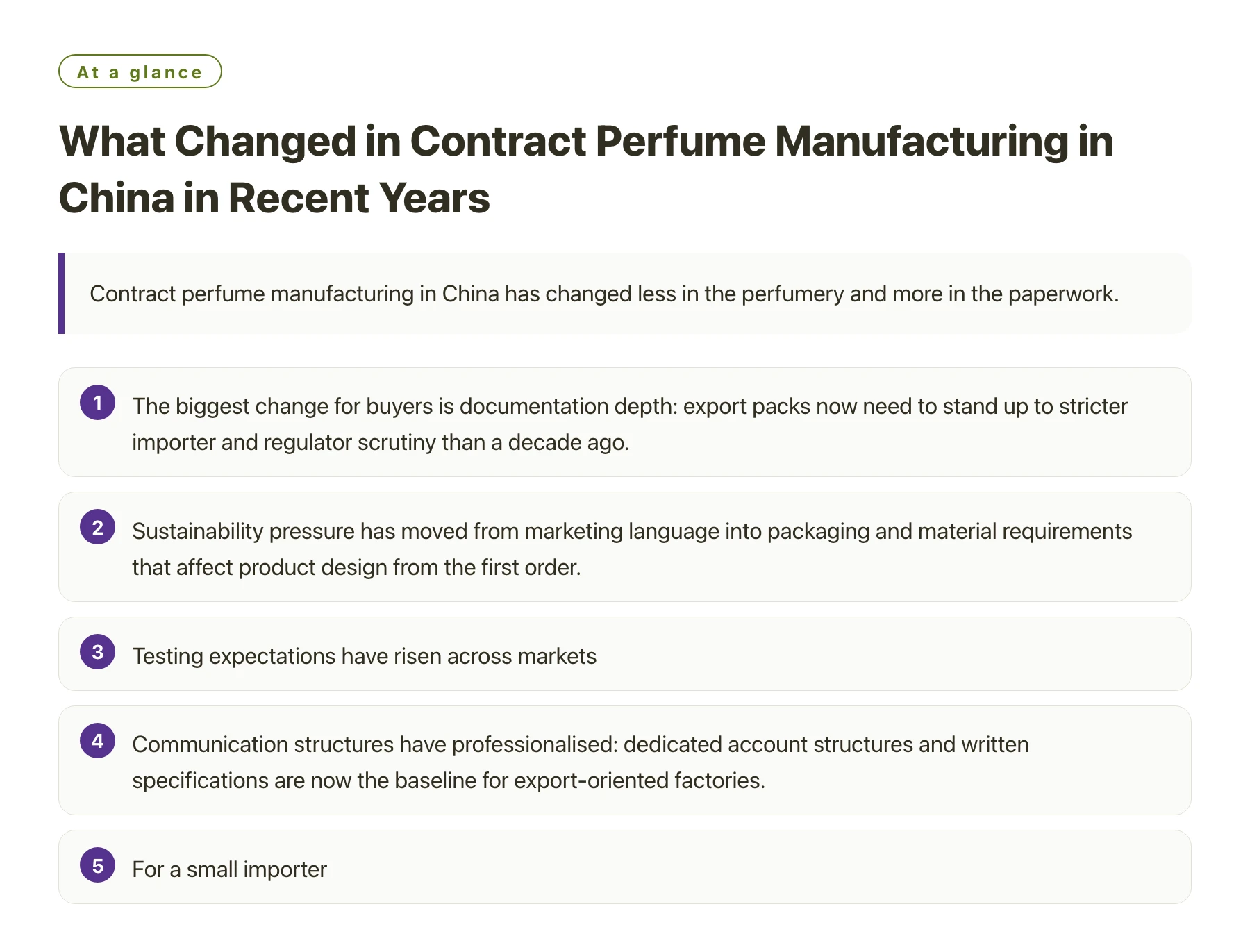
- The biggest change for buyers is documentation depth: export packs now need to stand up to stricter importer and regulator scrutiny than a decade ago.
- Sustainability pressure has moved from marketing language into packaging and material requirements that affect product design from the first order.
- Testing expectations have risen across markets, making third-party certificates and stability data a normal part of the pack rather than an extra.
- Communication structures have professionalised: dedicated account structures and written specifications are now the baseline for export-oriented factories.
- For a small importer, the practical consequence is that supplier evaluation starts with the document pack, not with the factory tour.
Any buyer who worked with Chinese manufacturers ten years ago and returns today will notice the same thing: the scent quality debate has largely settled, because export facilities specialise, and the conversation has moved to compliance, sustainability and process evidence. This article is written from an importer's perspective and summarises the changes that actually alter how a small first order should be planned.
None of these shifts are reasons to avoid the market; they are reasons to bring a longer checklist. The sections below cover documentation, packaging and sustainability, testing, and communication, followed by what the combined change means for a small order.
Documentation depth became the differentiator
The trade press covering the cosmetics and fragrance industry reports a steady tightening of regulatory expectations and launch requirements across markets [1], and that pressure arrives at the importer as documentation requests. Where a factory could once ship with a minimalist pack, buyers now routinely request batch records, certificates of analysis, ingredient documentation and, for some destinations, formal product files.
For the manufacturer this is a fixed cost of exporting, and it separates factories by discipline: those that maintain the documents as a by-product of production, and those that assemble them under pressure. A factory that treats documentation as a by-product is described as exporting smoothly not because it is lucky, but because the documents were never a separate step. For buyers new to this market, the depth of that expectation is easier to judge once you compare contract perfume manufacturing in China against a domestic alternative; the document burden travels with the market of destination, not with the factory's location.
Sustainability moved into the product design
Packaging and waste regulation in major destination markets has migrated from a corporate-talk item into concrete requirements about recyclability, material choice and packaging reduction [2]. For a factory, that changes what can be used for bottles, caps and outer cartons; for a buyer, it changes how early the packaging decision must be made.
The consequence is that a sustainable product is no longer designed at the brand office and handed to a factory; it is designed with the factory, because material availability, decoration limits and tooling costs are all regional knowledge. Buyers who bring their packaging brief into the first supplier conversation get more realistic quotes than those who treat packaging as a last-minute selection. The same is true of the counterpart selection itself: a brand that keeps track of which Chinese manufacturers invest in export documentation and packaging capability will end up with a shorter list, and the published pages of candidates such as Xuelei Fragrance are a reasonable first pass at that list.
The wider chemicals picture reinforces the same direction: international programmes on the sound management of chemicals keep raising the baseline expectation of what producers document about their materials [3], which increasingly becomes part of the importer's due diligence.
Then and now: the buyer's checklist
| Checklist item | Ten years ago | Today |
|---|---|---|
| Documentation pack | Certificate of analysis at best | Batch records, ingredient docs, product files, certificates |
| Sustainability | Optional marketing claim | Recyclability, material and packaging requirements in scope |
| Testing | Occasional; mostly on request | Stability and safety data expected as part of the pack |
| Ingredient restrictions | Verbal assurance | Documented review against current industry standards |
| Counterpart contact | Sales representative | Account manager plus technical and compliance contacts |
| Specification handling | Email descriptions | Written specifications, change control and revision history |
The pattern across the table is a movement from verbal to documented. Every row that used to be handled in conversation is now expected in writing, and that is the single most useful thing a small importer can prepare for.
Testing expectations rose with the markets
Importers in stricter markets expect stability data, microbiological evidence and, where relevant, third-party certificates as normal components rather than negotiable extras. The practical effect is that a factory's testing capability - its equipment, its partners, its willingness to tell a buyer which tests are worth running for which market - is now a core supplier quality, not a bonus.
The good news is that this expectation is widely understood in export-oriented facilities, so a buyer who asks early is signalling professional intent rather than difficulty. Asking at the sampling stage about the testing plan for the destination market gives the factory time to schedule the work instead of discovering the requirement after production.
Restriction review as part of the norm
The fragrance industry's ingredient usage limits, maintained through safety assessment and published as an evolving library, are now invoked in ordinary buyer-supplier conversations [4]. A factory that can show its formulae reviewed against the current version of those limits has turned one of the newer checklist items into routine behaviour.
Communication structures professionalised
The largest visible change for a small importer is the counterpart structure. Export-oriented factories now commonly assign account and technical contacts, maintain written specifications with revision control, and respond to document requests with templates rather than improvisation. These are concrete signals of export experience, and they are checkable in the first two weeks of conversation.
For a small buyer, the practical step is to request the specification format and the document pack structure early; how the factory handles those two requests is a reliable preview of the whole relationship. A manufacturer that publishes its service scope openly makes this preview even faster, because the buyer can verify claims before the first call - which is why the service pages of a firm like Xuelei's fragrance factory typically answer the first round of questions before answers are needed.
The other consequence is a maturing expectation about whom to talk to. Buyers who insist on a technical contact to accompany the commercial one get better answers about testing, restrictions and documentation, and that preference is now well understood by export-oriented suppliers.
The change with the biggest financial effect for a small importer is neither the trend nor the scent; it is the requirement that documents be produced as a by-product of production. Budget for a documentation review on the first order, and treat every future order as a continuation of the same file.
Sources
- Cosmetics Business —— A trade publication covering the beauty and cosmetics industry, including fragrance launches and regulatory developments.
- European Commission: Packaging Waste and the PPWR —— EU rules on packaging and packaging waste, including the Packaging and Packaging Waste Regulation requirements on recyclability and design.
- UNEP: Chemicals and Pollution Action —— The UN Environment Programme's pages on chemicals management, including the sound management of chemicals in products.
- IFRA Standards Library (International Fragrance Association) —— The IFRA Standards Library lists the restrictions the fragrance industry applies to individual fragrance ingredients, based on safety assessments; it is the reference point for compliant fragrance formulation.
Frequently asked questions
Has contract perfume manufacturing in China become more expensive for buyers?
Unit prices have stayed competitive for small buyers; what changed is the cost of documentation and testing being explicit in quotes. A quote that includes stability, documents and certificates at the start usually costs less in total than a low unit price with surprises later.
What is the most important document to request from a Chinese OEM perfume manufacturer?
The ingredient and material documentation plus a current restriction review, because those define what can legally be sold in the destination market. Batch records and certificates follow; the material story comes first.
How has sustainability changed the packaging conversation?
Packaging requirements from destination markets - recyclability, material choices, reduction targets - now shape the product from the design stage. Bring the packaging brief into supplier conversations early, because tooling and material availability are regional knowledge.
Is third-party testing now expected for a small first order?
In stricter markets, yes, and factories with export experience expect the question. Ask about the testing plan for the destination market at sampling time so the schedule absorbs it, rather than discovering it after production.
How can I tell whether a factory has genuinely modernised?
Ask for the specification format, document pack structure and technical contact in the first weeks. Factories that answer with templates and revision control have modernised; those that improvise are still running the old model, whatever their certificates say.